
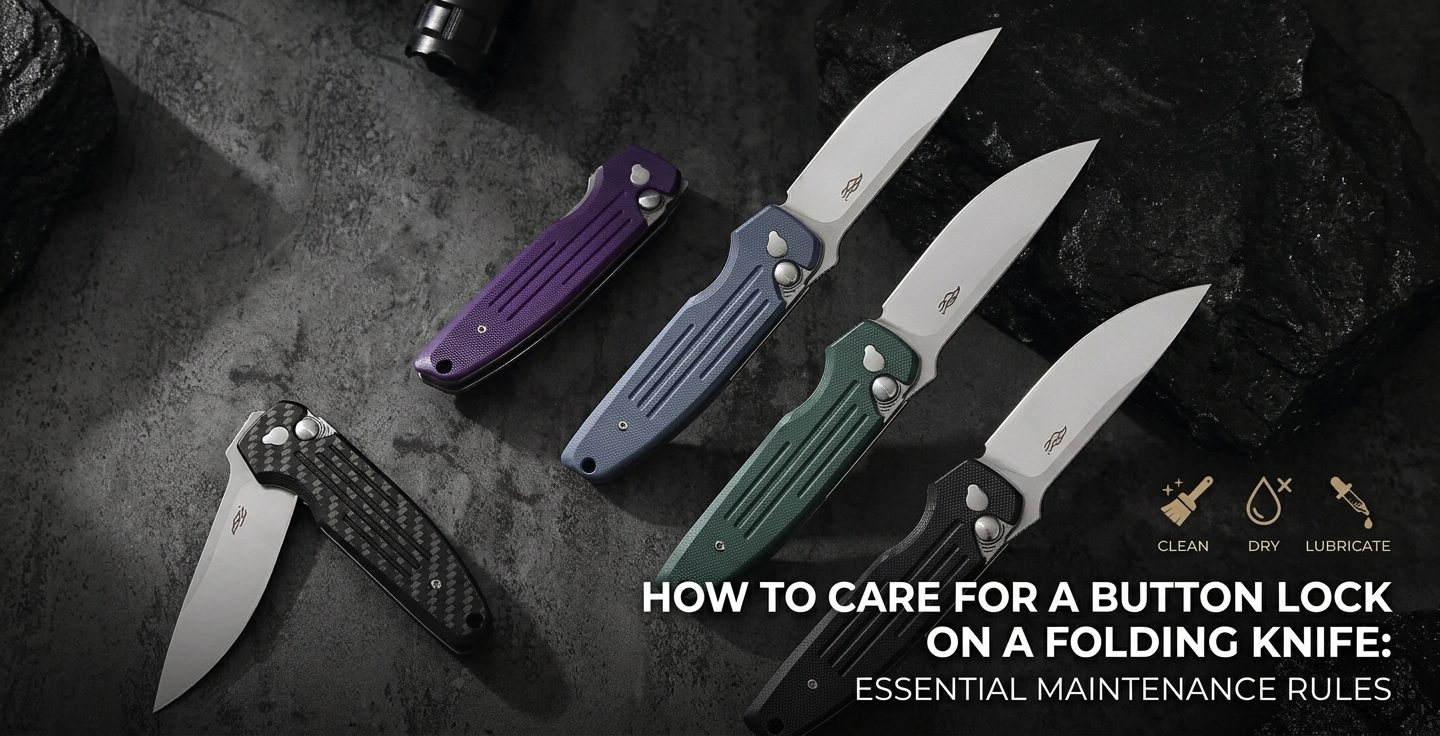
A button lock is a convenient and increasingly popular locking mechanism on modern folding knives. It allows the blade to open and close smoothly while providing a secure lock during use. Models such as the Firebird FH926 and Firebird FH925 combine this type of locking mechanism with a practical folding-knife design suitable for everyday and outdoor use.
However, like any mechanical system, a button lock needs proper care to maintain smooth operation and reliable performance.
We are often asked how to maintain a folding knife with a button lock, especially after outdoor use. So, we have collected the most important maintenance tips in one guide.
Why Does a Button Lock Need Maintenance?
The button lock mechanism consists of several precisely fitted components that work together every time the knife is opened or closed. Dust, sand, moisture, pocket lint, and other debris can gradually get inside the mechanism.
Over time, contamination may cause:
- The button to become harder to press.
- The blade to open or close less smoothly.
- The locking mechanism to feel sluggish.
- Unwanted noise or friction during operation.
- Accelerated wear of internal components.
Regular basic maintenance helps keep the mechanism clean and functioning as intended.
1. Keep the Lock Mechanism Clean
The most important rule is simple: don't let dirt accumulate inside the mechanism.
This is particularly important if you use your knife while hiking, camping, fishing, or working outdoors.
After using the knife in dusty or dirty conditions:
- Remove visible dirt from the handle and around the button.
- Carefully clean accessible areas around the lock.
- Use a soft brush or cloth to remove loose particles.
- Make sure the knife is completely dry before storing it.
Avoid pushing dirt deeper into the mechanism with sharp objects.
2. Pay Special Attention to Sand and Fine Dust
Sand is one of the worst contaminants for any folding-knife mechanism.
Fine particles can get into the button mechanism and pivot area, increasing friction and making the action feel gritty.
If you've taken your knife to the beach, desert, or a particularly dusty trail, give it some extra attention afterward.
Don't repeatedly press the button if you can feel sand or grit inside. Clean the mechanism first.
3. Use Lubricant Sparingly
A small amount of appropriate knife lubricant can help maintain smooth operation.
However, more lubricant does not mean better lubrication. Excess oil can attract dust and turn into an abrasive mixture inside the mechanism.
Apply only a small amount to the areas recommended by the knife manufacturer. Afterward, operate the mechanism several times and wipe away any excess.
The goal is smooth movement—not an oily knife.
4. Don't Use Aggressive Chemicals
Household cleaners, solvents, penetrating oils, and other aggressive chemicals may not be suitable for every knife.
They can potentially affect:
- Handle materials
- Coatings
- Lubricants
- Internal components
For routine maintenance, stick to products that are specifically suitable for folding knives and follow the manufacturer's recommendations.
5. Keep the Knife Dry
Moisture is another enemy of mechanical components.
If your knife gets wet during rain, fishing, camping, or another outdoor activity, dry it as soon as practical.
Pay particular attention to:
- The button area
- Pivot
- Blade
- Screws
- Handle gaps
Don't put a wet knife into a pocket or closed storage case for a long period.
6. Don't Force a Stiff Button
If the button suddenly becomes difficult to press, don't try to solve the problem by applying more force.
A stiff button can indicate that dirt, debris, corrosion, or another issue is affecting the mechanism.
Instead:
- Stop using excessive force.
- Inspect the mechanism.
- Clean the accessible areas.
- Apply an appropriate amount of lubricant if recommended.
- If the problem remains, contact the manufacturer or an experienced knife service professional.
A mechanical problem is easier to solve before it becomes a damaged component.
7. Avoid Unnecessary Button Pressing
It can be tempting to repeatedly flip a knife open and closed just because the mechanism feels satisfying.
Occasional operation is perfectly normal, but unnecessary repetitive cycling adds wear without providing any practical benefit.
Use the button lock for its intended purpose and avoid deliberately putting additional stress on the mechanism.
8. Check the Knife After Heavy Outdoor Use
After a demanding trip, take a minute to inspect the entire knife. This is especially useful for outdoor-oriented models such as the Firebird FH926 and Firebird FH925 , which may be exposed to dust, moisture, and other environmental conditions during use.
Check whether:
- The blade opens and closes normally.
- The button moves smoothly.
- The lock engages properly.
- There is unusual blade play.
- Screws have loosened.
- Dirt or moisture is present around the mechanism.
If something feels different from normal, investigate it before continuing to use the knife.
9. Don't Disassemble the Lock Without Knowing What You're Doing
A button-lock mechanism may contain small components, springs, and precisely fitted parts.
Complete disassembly isn't necessary for routine cleaning and maintenance.
If you don't have experience servicing folding knives, it's better to avoid unnecessary disassembly. Incorrect reassembly can affect the operation of the mechanism.
For more serious problems, professional service is the safest option.
10. Store Your Knife Properly
Good storage is part of knife maintenance.
When you're not using your folding knife:
- Store it clean and dry.
- Avoid prolonged exposure to humidity.
- Don't leave it covered in dirt after an outdoor trip.
- Keep it away from corrosive substances.
- Avoid storing it under heavy objects that could put pressure on the mechanism.
A few simple habits can significantly reduce maintenance problems.
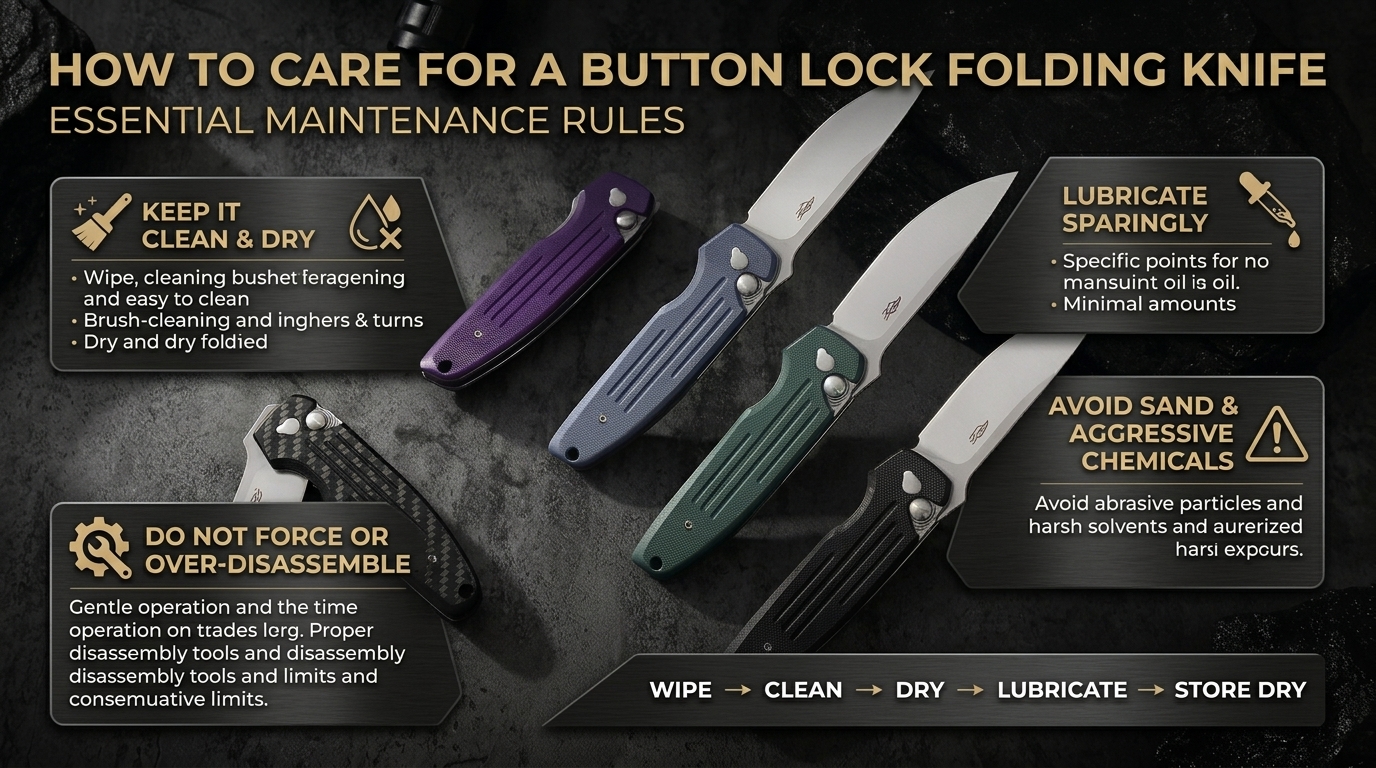
A Simple Maintenance Routine
You don't need to spend a lot of time maintaining a button-lock folding knife.
After everyday use
Wipe → Inspect → Store dry
After outdoor use
Clean → Dry → Inspect → Lubricate if necessary → Store
If the button feels different
Stop forcing it → Check for contamination → Clean → Test → Seek service if needed
This simple routine is usually enough to keep your folding knife operating smoothly.
What Should You Avoid?
Here is a quick checklist of things that can negatively affect a button lock:
❌ Don't force a stiff button.
❌ Don't flood the mechanism with oil.
❌ Don't leave sand and dirt inside the handle.
❌ Don't store the knife while it is wet.
❌ Don't use aggressive chemicals without checking compatibility.
❌ Don't disassemble the mechanism unnecessarily.
❌ Don't ignore unusual blade play or changes in lock operation.
Instead, keep the mechanism clean, dry, lightly lubricated when appropriate, and regularly inspected.
Final Thoughts
A button-lock folding knife is a precision mechanical tool, and proper maintenance doesn't have to be complicated. Whether you use a Firebird FH926 and Firebird FH925 or another folding knife with a button lock, most everyday maintenance comes down to a few basic principles: keep it clean, keep it dry, use lubricant sparingly, and don't force the mechanism.
We often receive questions about how to care for button-lock knives, so we hope these simple recommendations will help you get the best performance and a long service life from your knife.
Take care of your knife, and it will be ready for the next adventure.
